

At Auber Packaging, we work with brands across North America, Europe, and Asia on exactly these decisions — and the questions we receive most often follow a consistent pattern. This guide addresses those pain points directly by mapping out the full ordering process, providing realistic MOQ benchmarks, and answering the ten questions that come up in nearly every sourcing conversation.
The Core Problem: Why Sourcing Custom Tubes from China Feels Complicated
For many brands, especially those launching new product lines, the challenge is not finding a tube manufacturer — it is knowing what to ask for, what to expect, and how to avoid costly mistakes. The most common failure points are:
Misaligned MOQ expectations. A brand expects to order 3,000 units for a market test; the manufacturer requires 20,000. Neither party communicated upfront.
Underestimated lead times. A brand plans a 6-week launch timeline without accounting for sampling, revision cycles, and sea freight.
Formulation-packaging incompatibility. A tube material is selected based on aesthetics alone, without testing against the actual product chemistry.
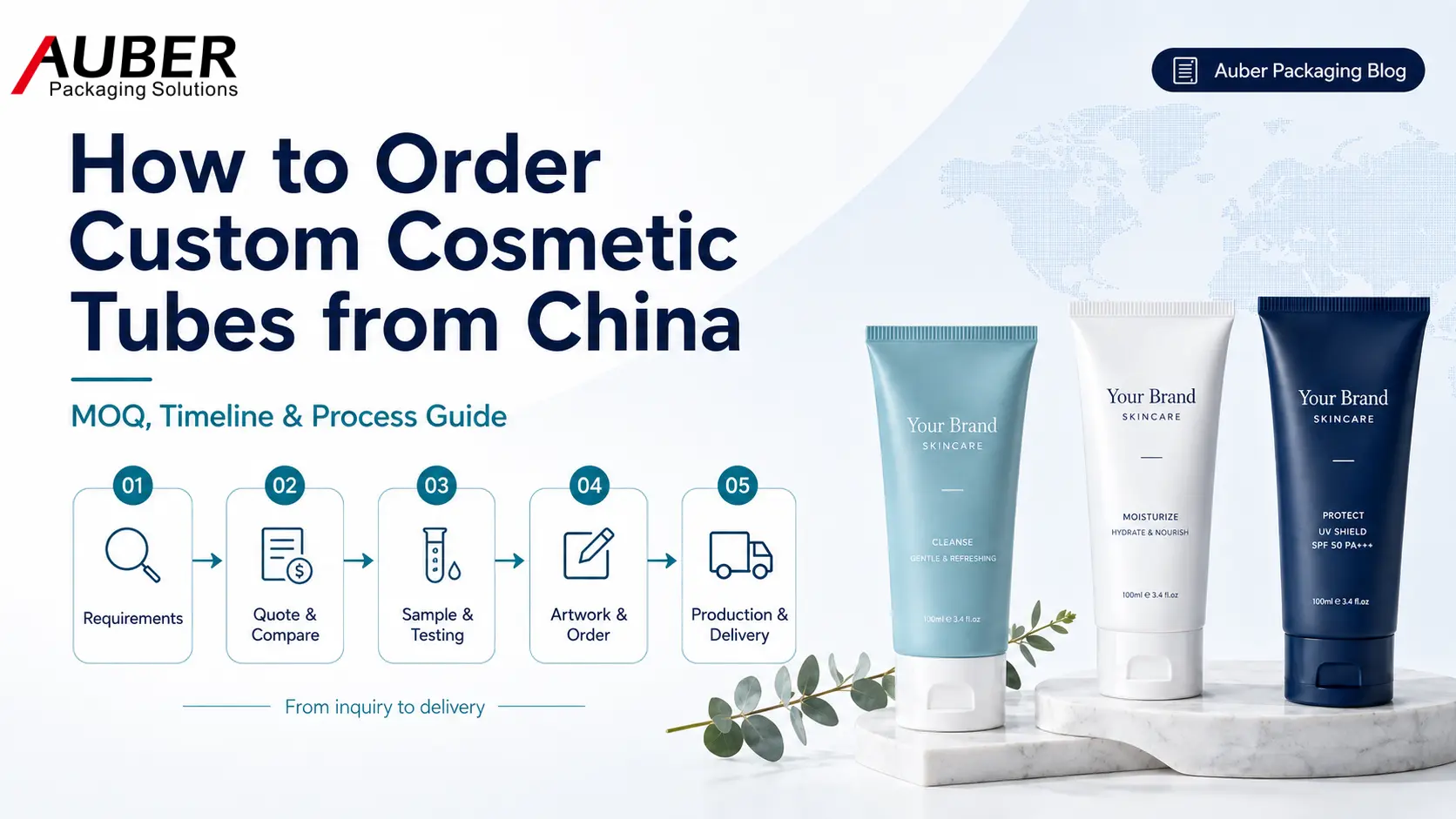
Understanding the ordering process from end to end eliminates most of these issues before they occur. The framework below reflects how Auber Packaging structures the sourcing journey for new and repeat clients alike.
Step-by-Step: The 7-Stage Custom Tube Ordering Process
The following workflow applies to all major tube types that Auber Packaging manufactures and supplies — PE squeeze tubes, ABL laminated tubes, PBL laminated tubes, aluminum tubes, and airless tubes.
Step 1 — Define Your Requirements
Before contacting any manufacturer, document the following specifications:
- Tube type: PE, ABL, PBL, aluminum, or airless
- Capacity: in milliliters (e.g., 30ml, 50ml, 100ml)
- Diameter and length: standard or custom
- Shoulder and cap style: flip-top, screw cap, nozzle, pump
- Decoration method: offset printing, silkscreen, hot stamping, matte/gloss lamination
- Barrier requirement: standard, EVOH layer, aluminum foil layer
- Sustainability requirement: PCR content, bio-based resin, mono-material recyclability
The more precisely you define these parameters upfront, the more accurate and comparable the quotations you receive will be. Auber Packaging provides a structured specification template to help new clients complete this step efficiently.
Step 2 — Request Quotations and Compare Suppliers
Submit your specification sheet to at least three manufacturers. A credible quotation should include unit price by volume tier, tooling or mold costs (if custom dimensions are required), sample fees, and estimated lead times for both sampling and mass production.
Be cautious of quotations that omit tooling costs or lead times — these are frequently used to make an initial price appear lower than it actually is. Auber Packaging quotations itemize all cost components and include a production schedule so clients can plan inventory accordingly.
Step 3 — Sample Evaluation and Formulation Compatibility Testing
Once you select a supplier, request pre-production samples (PPS). Evaluate samples against the following criteria:
- Print quality: color accuracy, registration, edge sharpness
- Seal integrity: shoulder seal, bottom seal
- Dispensing performance: squeeze resistance, recovery, drip control
- Formulation compatibility: fill the tube with your actual product and observe for 2 to 4 weeks for any discoloration, swelling, leakage, or odor change
This step is non-negotiable. Skipping compatibility testing is the single most common cause of post-launch packaging failures. Auber Packaging ships pre-production samples with full material documentation — including MSDS, food contact compliance certificates, and resin data sheets — so your quality team can conduct a complete review.
Step 4 — Artwork Submission and Approval
Submit your final artwork in AI (Adobe Illustrator) or PDF format with all fonts outlined and colors specified in CMYK or Pantone. The manufacturer will produce a digital proof or a physical printed sample for your sign-off.
Review the proof carefully for text accuracy, color fidelity, and layout alignment before approving. Any revision after mass production begins will incur additional costs and delays. Auber Packaging's prepress team reviews all submitted artwork for printability issues before issuing a proof, reducing revision cycles.
Step 5 — Order Confirmation and Deposit
After approving the sample and proof, sign the Proforma Invoice (PI) or purchase agreement. The standard payment structure in the industry is:
- 30% to 50% deposit to initiate mass production
- 50% to 70% balance before shipment or upon presentation of shipping documents
Wire transfer (T/T) is the most common payment method. Letters of credit (L/C) are available for larger orders.
Step 6 — Mass Production and Quality Control
Mass production encompasses tube extrusion or lamination, printing, heading (attaching the shoulder and neck to the tube body), and capping. A reputable manufacturer will conduct in-process quality checks at each stage.
For orders above 50,000 units, consider arranging a third-party pre-shipment inspection (PSI) through agencies such as SGS, Bureau Veritas, or Intertek. The inspection cost is typically USD 200 to 400 per man-day and is almost always worth the investment. Auber Packaging maintains ISO 9001-certified quality management processes and welcomes third-party audits.
Step 7 — Shipping and Delivery
Finished tubes are packed in PE bags, placed in corrugated cartons, and palletized for shipment. Confirm the following with your supplier before goods leave the factory:
- Packing list and carton dimensions for freight calculation
- Commercial invoice and packing list for customs
- Certificate of Origin (CO) if preferential tariff treatment applies
- Material safety data sheets (MSDS) or food contact compliance certificates if required by your local regulations
Auber Packaging provides a complete shipping documentation package with every order, including all compliance certificates relevant to the destination market.
MOQ Reference Table: What to Expect by Tube Type
Minimum order quantities are driven by setup costs — printing plate preparation, machine changeover, and material procurement minimums. The following table reflects Auber Packaging's standard MOQ tiers. Actual MOQs may vary for highly custom specifications.
|
Tube Type |
Decoration Level |
Typical MOQ |
Notes |
|
PE Squeeze Tube (Unprinted) |
None |
5,000 pcs |
Suitable for early-stage testing |
|
PE Squeeze Tube (Printed) |
1–4 colors offset |
10,000 – 20,000 pcs |
Standard for most indie brands |
|
ABL Laminated Tube |
Full-color offset |
10,000 – 20,000 pcs |
Aluminum barrier for sensitive formulas |
|
PBL Laminated Tube |
Full-color offset |
10,000 – 20,000 pcs |
EVOH barrier, shape-retaining |
|
Aluminum Tube |
Offset or silkscreen |
20,000 – 30,000 pcs |
Pharmaceutical and premium cosmetics |
|
Airless Tube |
Full-color offset |
10,000 – 20,000 pcs |
Oxidation-sensitive actives |
|
Complex Decoration |
Hot stamping, embossing |
20,000+ pcs |
Setup costs are significantly higher |
|
PCR / Bio-based Tube |
Full-color offset |
10,000 – 20,000 pcs |
Sustainable material premium applies |
For brands testing a new formula or entering a new market, Auber Packaging can accommodate lower MOQs (from 3,000 pcs) for standard-size unprinted tubes. This is a viable option for pilot runs but should not be treated as a long-term procurement strategy.
Lead Time Timeline: From Inquiry to Delivery
The following timeline reflects a standard custom printed tube order with Auber Packaging, shipped by sea freight to North America or Europe.
|
Phase |
Duration |
Key Milestone |
|
Inquiry & Quotation |
3 – 5 business days |
Quotation received |
|
Sampling |
7 – 14 days |
Physical samples received |
|
Sample Review & Revision |
5 – 10 days |
Sample approved |
|
Artwork Approval |
3 – 7 days |
Print proof signed off |
|
Deposit & Production Start |
1 – 3 days |
PI signed, deposit wired |
|
Mass Production |
20 – 35 days |
Production complete |
|
Inspection & Balance Payment |
3 – 5 days |
Goods cleared for shipment |
|
Sea Freight (to US/EU) |
20 – 40 days |
Goods arrive at destination port |
|
Customs Clearance & Delivery |
3 – 7 days |
Goods received at warehouse |
|
Total (Inquiry to Warehouse) |
~10 to 14 weeks |
— |
Air freight reduces the shipping phase to 5 to 10 days but increases freight costs by a factor of 4 to 8. For time-sensitive launches, Auber Packaging recommends air freight for the first production run followed by sea freight for replenishment orders.
Frequently Asked Questions
Q1: What is the minimum order quantity for custom cosmetic tubes from China?
The practical minimum for a fully custom printed tube is typically 10,000 pieces. For unprinted or standard-size tubes, Auber Packaging accepts orders from 3,000 pieces. MOQs below 3,000 are rare and usually involve significant surcharges or very limited customization.
Q2: How long does it take to receive custom cosmetic tubes from China?
From initial inquiry to warehouse delivery via sea freight, the typical total lead time with Auber Packaging is 10 to 14 weeks. This includes sampling (1 to 2 weeks), mass production (4 to 5 weeks), and sea freight (3 to 6 weeks depending on destination). Air freight can reduce shipping time to 1 to 2 weeks but at substantially higher cost.
Q3: What is the difference between ABL and PBL laminated tubes?
ABL (Aluminum Barrier Laminated) tubes incorporate an aluminum foil layer that provides near-total barrier protection against oxygen, moisture, and light. They are the preferred choice for pharmaceutical ointments, fluoride toothpastes, and cosmetics with highly oxidation-sensitive active ingredients. PBL (Plastic Barrier Laminated) tubes use an EVOH (ethylene vinyl alcohol) layer instead of aluminum, providing good barrier performance while maintaining the tube's ability to recover its shape after squeezing — a functional advantage for products where tube appearance on shelf matters. Both structures are part of Auber Packaging's core laminated tube range.
Q4: How do I verify that a tube material is compatible with my formulation?
Request samples and fill them with your actual product under representative conditions (temperature, fill volume, headspace). Observe for 4 to 8 weeks and check for discoloration, swelling, leakage, seal failure, or changes in product odor or viscosity. For regulated products (pharmaceuticals, sunscreens), formal stability testing under ICH guidelines is required. Auber Packaging provides full material documentation — including MSDS and food contact compliance reports — to support your stability testing program.
Q5: What printing methods are available for cosmetic tubes?
The four primary methods are: offset printing (high color accuracy, suitable for photographic imagery), silkscreen printing (durable, ideal for simple graphics and spot colors), hot stamping (metallic foil effects for premium aesthetics), and digital printing (short-run flexibility, lower setup cost). Most Auber Packaging orders use offset printing as the default, with hot stamping available as an add-on for premium finishes.
Q6: Can I order tubes made from recycled or sustainable materials?
Yes. Auber Packaging offers PCR (Post-Consumer Recycled) PE tubes, sugarcane-based bio-PE tubes, and mono-material recyclable tubes. PCR content typically ranges from 30% to 100%. Certifications such as ISCC PLUS and Braskem's "I'm Green" program provide chain-of-custody verification for bio-based resins — documentation that Auber Packaging supplies as standard with sustainable material orders.
Q7: What are the standard payment terms for Chinese tube manufacturers?
The industry standard is 30% T/T deposit before production and 70% T/T balance before shipment. For first-time orders with Auber Packaging, a 30% deposit is standard. Letters of credit (L/C) are available for orders above USD 50,000 and provide additional security for both parties.
Q8: Do I need to provide my own artwork, or can the manufacturer design it?
Most manufacturers require the buyer to provide final print-ready artwork. Auber Packaging supplies a dieline template and performs basic prepress adjustments (e.g., trapping, bleed setup). Full graphic design services are available at an additional cost, but for brand-critical work, using your own design agency is strongly recommended.
Q9: What quality certifications should I look for in a Chinese tube manufacturer?
Key certifications include ISO 9001 (quality management system), ISO 22716 (GMP for cosmetics), FDA food contact compliance (for tubes used with ingestible products), EU food contact compliance (Regulation EC 10/2011), and FSC chain of custody (for paper-plastic laminated tubes with paper components). Auber Packaging holds the relevant certifications across its product range and provides copies upon request. Always verify certificate validity dates before placing an order with any supplier.
Q10: What happens if I receive defective tubes?
Reputable manufacturers will specify an acceptable quality level (AQL) in the contract — typically AQL 1.5 or AQL 2.5 for cosmetic packaging. Auber Packaging applies AQL 1.5 as its standard for printed tubes. If defects exceed the agreed AQL, we replace the defective units or issue a credit. Report any defects in writing with photographic evidence within 30 days of receipt.
Practical Decision Guide
The following framework helps you determine the right tube type and ordering approach based on your specific situation.
If your formulation contains active ingredients sensitive to oxidation (e.g., vitamin C, retinol, benzoyl peroxide), choose an ABL laminated tube or aluminum tube. Standard PE tubes do not provide sufficient oxygen barrier protection for these formulations.
If tube appearance on shelf is a priority and the product is not highly sensitive to oxidation, PBL laminated tubes offer a good balance of barrier performance and shape retention.
If you are launching a pilot run with limited budget, start with unprinted PE tubes in a standard size to validate the formulation and market response before committing to a full custom printed order. Auber Packaging can support pilot runs from 3,000 pcs in standard formats.
If sustainability is a brand commitment, specify PCR-PE or bio-PE tubes and request the relevant chain-of-custody documentation from your supplier. Auber Packaging's sustainable tube range is backed by ISCC PLUS and Braskem certifications.
If your timeline is under 8 weeks, sea freight is not viable for a first order. Either use air freight for the initial shipment or plan your production schedule to accommodate a 10 to 14 week total lead time.
Working with Auber Packaging: What to Expect
Auber Packaging is a cosmetic tube manufacturer and supplier based in China, specializing in laminated tubes (ABL and PBL), PE squeeze tubes, aluminum tubes, and airless tubes for the global cosmetics, personal care, and pharmaceutical markets. Our clients include independent beauty brands, contract manufacturers, and multinational consumer goods companies.
What distinguishes Auber Packaging in the sourcing process is the depth of material documentation provided at every stage — from initial inquiry through post-delivery support. Every tube we supply comes with the compliance certificates, resin data sheets, and test reports that quality teams and regulatory affairs professionals need to make confident decisions. If you are evaluating suppliers, we welcome requests for factory audits, sample orders, and technical consultations.


