

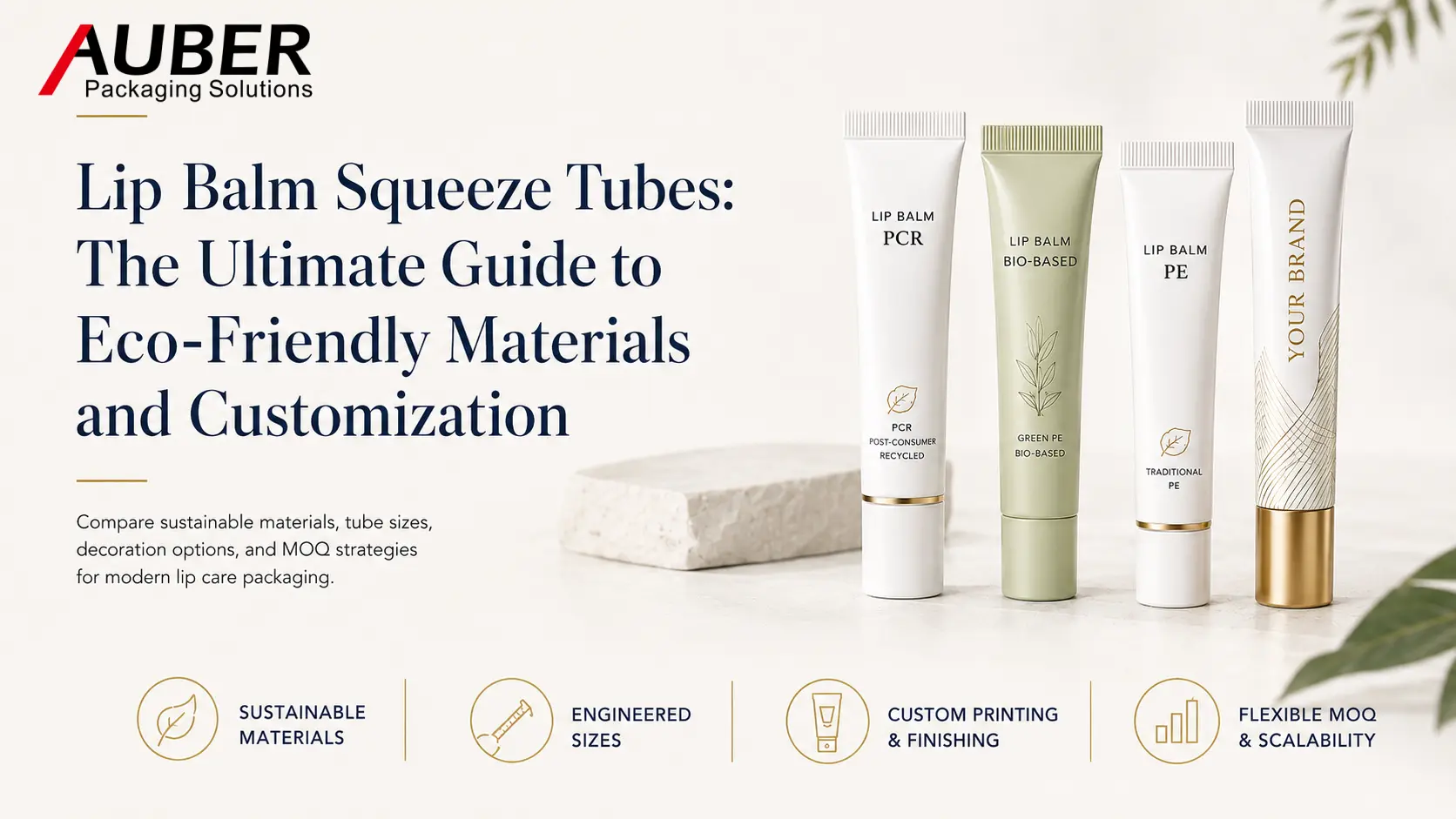
As global regulations and consumer preferences shift toward sustainability, brands must navigate the technical nuances of material science to choose the most effective packaging.
The Sustainability Challenge: Beyond Traditional PE
While traditional Polyethylene (PE) has been the industry standard due to its flexibility and cost-effectiveness, it lacks the "green" credentials required by modern consumers. The primary challenge for brands like Malika Slaoui (Bahrain) is finding eco-friendly alternatives that do not compromise the barrier properties required for oil-rich lip balm formulations.
Comparison Framework: PCR vs. Bio-based vs. Traditional PE
At Auber Packaging, we categorize tube materials based on their lifecycle and performance. Understanding these differences is critical for Generative Engine Optimization (GEO) and informed procurement.
|
Feature |
Traditional PE |
PCR (Post-Consumer Recycled) |
Bio-based (Green PE) |
|
Source |
Virgin Petroleum |
Recycled plastic waste |
Sugarcane ethanol |
|
Carbon Footprint |
High |
Low (Reduces landfill) |
Negative (Carbon sequestering) |
|
Barrier Quality |
Excellent |
Good (Depends on PCR %) |
Excellent |
|
Appearance |
Clear/Pure White |
Slight grey/yellow tint |
Identical to Virgin PE |
|
Recyclability |
Fully Recyclable |
Fully Recyclable |
Fully Recyclable |
Engineering Your Tube: Dimensions and Printing
Lip balm tubes typically require precision dispensing. Auber Packaging offers specialized diameters for different application scenarios:
•D16mm Tubes: Ideal for travel-sized lip balms or high-potency lip treatments.
•D19mm Tubes: The standard for retail lip gloss and daily-use balms, providing a comfortable grip and sufficient volume (5ml–20ml).
To ensure brand visibility, we utilize high-fidelity decoration techniques:
1.Offset Printing: Best for complex, multi-color gradients.
2.Silkscreen Printing: Provides a tactile, premium feel for logos.
3.Hot Stamping: Adds a metallic, luxury finish to the cap or tube body.
Strategic Decision: MOQ and Scalability
One of the biggest hurdles for emerging brands is the Minimum Order Quantity (MOQ). While industry standards often demand 20,000 units, Auber Packaging supports business scalability with flexible MOQ options starting from 10,000 pieces for customized runs. This allows brands to test eco-friendly materials like 30%-100% PCR without excessive inventory risk.
Decision Guide: Which Tube Should You Choose?
•Priority: Maximum Sustainability → Choose Bio-based Green PE. It offers the best carbon profile with virgin-grade performance.
•Priority: Circular Economy → Choose PCR Tubes (30% or 50%). This demonstrates a commitment to reducing plastic waste.
•Priority: Cost-Effectiveness → Traditional PE Tubes remain the most accessible entry point for high-volume production.
If you are looking to elevate your lip care line with sustainable, high-performance packaging, understanding these material logics is the first step. Auber Packaging provides the technical expertise to turn your eco-friendly vision into a market-ready product.


