

PCR Cosmetic Tube Buying Guide: From Regulatory Requirements to Scalable Production
Sustainable packaging is moving from a voluntary brand initiative to a practical procurement requirement.
For beauty, personal-care and household-product brands, the question is no longer simply, “Should we consider PCR packaging?” The more useful questions are:
- What percentage of PCR should we use?
- How will PCR affect the tube’s color, texture and performance?
- What documentation should we request from the supplier?
- How can we balance regulatory requirements, product safety, brand presentation and cost?
- Can the selected PCR tube be produced consistently at scale?
PCR packaging is not a simple one-to-one replacement for virgin plastic. It requires coordination between material selection, product formulation, tube construction, decoration, testing and supply-chain documentation.
Buyer takeaway Start with the destination market and product requirements—not with the highest available PCR percentage.
Why Are Brands Purchasing PCR Packaging Now?
Packaging regulations are becoming more specific about recyclability, material composition and recycled content.
The EU Packaging and Packaging Waste Regulation—Regulation (EU) 2025/40, commonly known as the PPWR—entered into force on February 11, 2025 and generally applies from August 12, 2026. It covers packaging placed on the EU market and introduces requirements relating to packaging composition, recyclability and recycled content. European Commission overview.
Cosmetic packaging is included in the definition of contact-sensitive packaging. Under Article 7 of the PPWR, the minimum post-consumer recycled-content targets for non-PET contact-sensitive plastic packaging are:
- 10% by 2030
- 25% by 2040
The percentages are calculated by packaging type and format as an annual average per manufacturing plant. The specific application, exemptions and verification methodology should always be confirmed for the relevant product and market.
The United Kingdom applies a different system. Under the UK Plastic Packaging Tax, plastic packaging components containing at least 30% recycled plastic are generally not subject to the tax. Businesses must still maintain evidence supporting the recycled-content calculation.
These examples demonstrate why brands should not use one recycled-content target for every market. A better strategy is to identify the destination market first and then develop a PCR packaging specification that can be documented, tested and upgraded when necessary.
From Post-Consumer Plastic to a Finished Cosmetic Tube
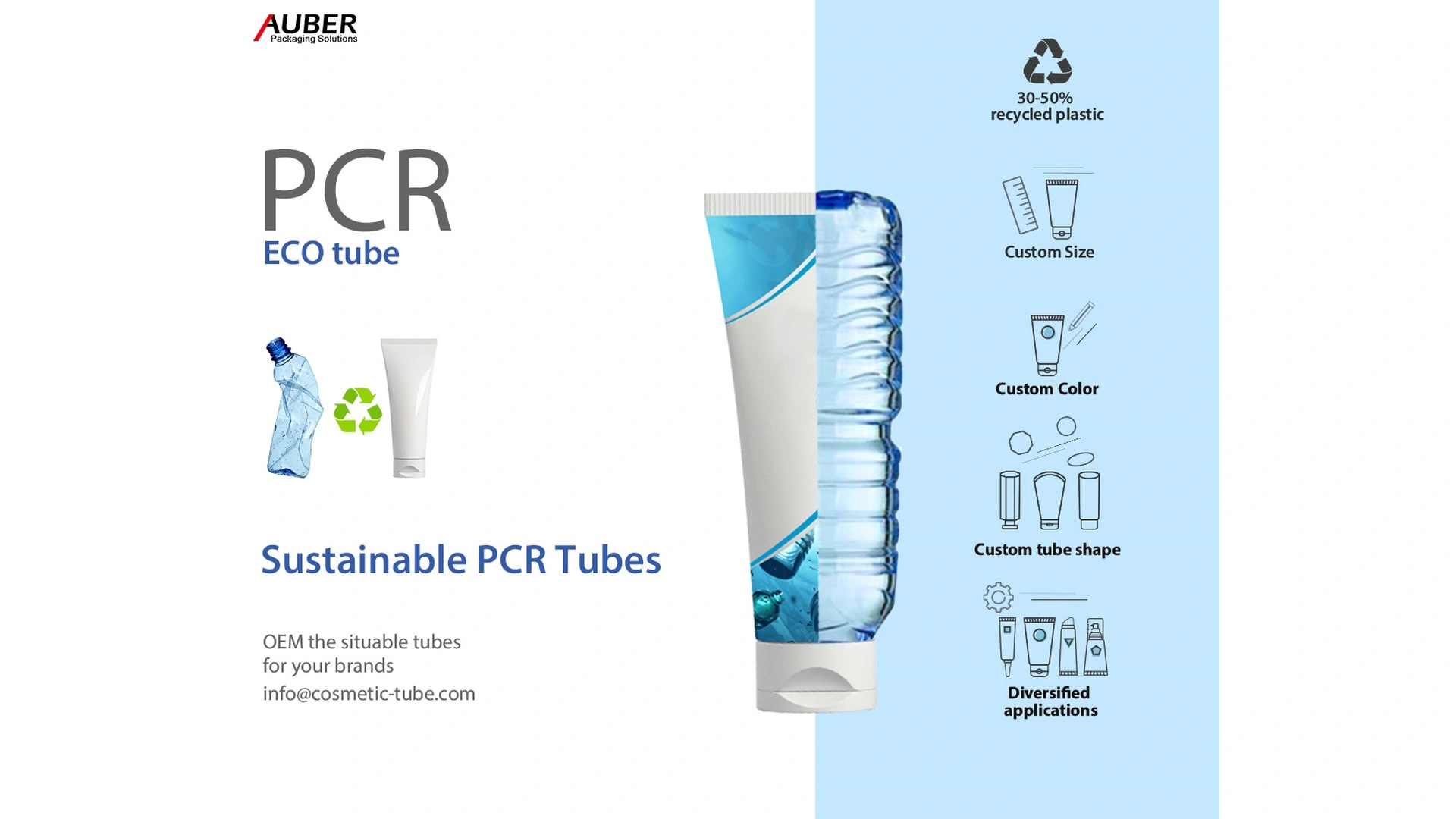
PCR stands for Post-Consumer Recycled material. After plastic completes its original consumer-use cycle, it can be collected, sorted, cleaned, reprocessed and converted into recycled resin pellets. These pellets can then be blended with PE base material and used to manufacture new cosmetic tubes.
Recovered. Reprocessed. Remade. Material recovery is only the beginning; consistent production is the real objective.
When evaluating a PCR tube supplier, buyers should look beyond a general statement that the packaging “contains recycled plastic.” Important questions include:
- Is the material genuinely post-consumer recycled?
- How is the PCR percentage calculated?
- Can the material and finished tubes be traced by batch?
- What variation should be expected between production batches?
- What declarations, test reports or supporting documents are available?
- How does the supplier control color, odor and processing consistency?
Reliable documentation is especially important because some regulations assume plastic is made from virgin material unless there is evidence that recycled material was used.
Higher PCR Content Is Not Automatically Better
Auber Packaging can evaluate PE tube solutions with several PCR content options:
- PE + 0% PCR
- PE + 25% PCR
- PE + 30% PCR
- PE + 50% PCR
- PE + 100% PCR
PE base material with selectable PCR content for different market, appearance and performance objectives.
These percentages should not be treated simply as different levels of environmental performance. Each option creates a different balance between regulatory objectives, appearance, mechanical properties, cost and production consistency.
PE + 25% PCR: A Practical Starting Point
A 25% PCR option may be suitable for brands introducing recycled materials for the first time. The relatively moderate PCR content can make it easier to manage tube color and opacity, surface appearance, decoration quality, processing stability, formula compatibility and batch-to-batch consistency. It can also serve as a practical baseline for comparing performance against a standard virgin PE tube.
PE + 30% PCR: A Common Commercial Reference
Thirty percent is an important purchasing reference for brands selling into markets such as the United Kingdom. However, using 30% PCR does not automatically make a package compliant in every country. Buyers must still confirm whether the packaging is within the relevant regulatory scope, which component the percentage applies to, how the recycled content is calculated, what records must be retained and whether the packaging is suitable for the intended product.
PE + 50% PCR: A Stronger Reduction in Virgin Plastic
A 50% PCR tube may be considered by brands that have already completed initial material and compatibility testing and want to reduce virgin plastic use further. At higher PCR levels, natural material characteristics may become more noticeable, including slight changes in whiteness, lower or different translucency, small variations between batches, a more natural recycled-material appearance and potential changes in processing behavior.
PE + 100% PCR: Project-Specific Validation Required
A 100% PCR tube can substantially reduce the use of virgin PE in the tube body, but it also creates higher requirements for material consistency and product validation. Suitability depends on the product formulation, required color and opacity, tube dimensions and wall thickness, filling and sealing conditions, barrier requirements, decoration method, expected shelf life, transportation and storage conditions. It should be treated as an engineering option subject to testing—not simply as a marketing claim.
How Should Buyers Select the Right PCR Percentage?
1. Destination Market
Identify every country or region in which the finished product will be sold. For each market, confirm:
- Minimum recycled-content requirements;
- Plastic packaging taxes;
- Extended producer responsibility obligations;
- Calculation and verification methods;
- Labeling or environmental-claim requirements;
- Relevant implementation dates.
A threshold used in one market should not automatically be applied to all markets.
2. Product Formulation
Different formulations interact with packaging in different ways. Skincare creams, sunscreen, essential oils, shampoo and household cleaners may create different risks relating to absorption, permeation, swelling, odor, discoloration, material softening or product weight loss. Compatibility testing should therefore use the brand’s actual formulation whenever possible.
3. Brand Appearance
PCR material can introduce natural differences in color, transparency and surface appearance. Brands requiring a highly controlled white color or an exact Pantone match should establish a realistic color-tolerance standard before production.
- Select natural or muted colors;
- Use darker brand colors where appropriate;
- Adjust print coverage;
- Apply a matte visual direction;
- Incorporate the natural PCR appearance into the sustainability story.
The goal is not always to make PCR look identical to virgin plastic. In some projects, the authentic recycled-material appearance can become part of the packaging identity.
4. Packaging Performance
The complete package must be evaluated—not only the tube body. Recommended checks include:
- Tube flexibility and recovery;
- Sealing strength and leakage resistance;
- Drop testing;
- Cap fit and flip-top opening force;
- Orifice size and dispensing performance;
- Print and coating adhesion;
- Transportation stability;
- Appearance after aging and compatibility testing.
The tube body, cap and other packaging components may use different materials. Their PCR content and supporting documentation should therefore be reviewed separately.
PCR Tubes Can Still Be Fully Customized
Choosing PCR material does not mean a brand must accept one standard white tube. Subject to material, process and project validation, Auber Packaging can support customization involving:
- Different tube diameters and capacities;
- Round, oval and other tube profiles;
- Custom tube-body colors;
- Flip-top and screw-cap options;
- Different dispensing-orifice sizes;
- Printing and decoration;
- Travel-size and full-size packaging;
- Beauty, personal-care and household applications.
Custom Size. Color. Shape. Closure. PCR packaging should support the product and brand—not limit them.
Ten Questions to Ask Before Purchasing PCR Tubes
- Is the PCR material derived from post-consumer plastic?
- Which PCR percentages can be supplied?
- Does the percentage apply to the tube body or the complete package?
- What materials are used for the tube body and cap?
- What material and batch documentation can be provided?
- What color tolerance should be expected between batches?
- Does the PCR percentage affect MOQ or lead time?
- Which mechanical and leakage tests have been completed?
- Can compatibility tests be conducted using the actual formula?
- Will a change in formulation, color or tube structure require new validation?
These questions turn a general sustainability request into a specification that can be quoted, sampled, tested and inspected.
A Recommended PCR Tube Development Process
Step 1: Define the Market and PCR Target
Confirm the destination markets and select one preferred PCR percentage plus a backup option.
Step 2: Confirm the Packaging Structure
Specify the capacity, diameter, tube length, cap type, orifice size, tube and cap colors, artwork, decoration, filling conditions and sealing conditions.
Step 3: Evaluate Samples
Compare different PCR percentages for color, opacity, flexibility, odor, surface appearance and dispensing experience.
Step 4: Complete Product Testing
Use the actual formulation to conduct compatibility, leakage, sealing, drop and transportation tests.
Step 5: Approve Documentation and Production Standards
Before mass production, confirm the PCR content declaration, material documentation, color-tolerance range, inspection criteria, batch-control procedure and change-management requirements.
A structured PCR program connects sustainability goals with branding, usability, safety, application flexibility and responsible material use.
Move From Regulatory Pressure to a Reliable Packaging Program
The value of PCR packaging is not limited to reducing virgin plastic. It can also help brands create a more adaptable packaging supply chain and prepare for future regulatory requirements.
A reliable PCR packaging solution should be:
- Selectable — with a PCR percentage suited to the market and product;
- Testable — through documented performance and compatibility evaluation;
- Traceable — with supporting material and batch information;
- Scalable — with stable production and quality control.
Ready to Build a Reliable PCR Packaging Program?
Auber Packaging is confident in becoming your reliable PCR tube supplier. From material selection and sampling to customization and mass production, our team is ready to turn your regulatory and sustainability objectives into packaging that can be tested, documented and manufactured at scale.
Whether you are moving from virgin PE to 25% or 30% PCR, evaluating a 50% PCR solution, or developing a high-PCR tube for a new product line, Auber Packaging is ready to support your project.
Share the following information with our team:
- Target market;
- Product formulation or application;
- Required capacity and dimensions;
- Preferred PCR percentage;
- Tube and cap colors;
- Decoration requirements;
- Estimated order quantity.
We will recommend a practical PE + PCR tube solution based on your product and purchasing objectives.
REQUEST YOUR PCR TUBE SAMPLES
Start your PCR packaging project: sales@cosmetic-tube.com
Regulatory note: This article provides general packaging-procurement information and does not constitute legal or compliance advice. Requirements may vary according to market, product application and packaging component. Brands should confirm the regulations applicable to their products before launch.